
What Is a Horizontal Ribbon Mixer and How Does It Work?

A Horizontal Ribbon Mixer is a batch machine designed to blend powders and granules with controlled, repeatable movement. Inside its U-shaped trough, a horizontal shaft carries inner and outer helical ribbons. As the ribbons turn, they move material in opposing directions, folding ingredients through the mixer rather than simply spinning them in place. The result depends on more than the machine’s name. Fill level, particle size, moisture, mixing time, and discharge design all affect performance. Small details matter.

A practical engineering principle captures the goal: “Good mixing is controlled movement, not simply faster movement.” This is an editorially written principle, not a verified quotation from a named industry expert. A real expert’s name and direct quotation should be added only when supported by a reliable source. That distinction matters. For operators and equipment buyers, understanding the mixing action helps explain why a ribbon mixer may suit one formulation but not another. It also helps teams ask sharper questions about batch uniformity, cleaning access, and scale-up. Imagine fine powder collecting near a trough wall, or a damp ingredient forming stubborn pockets. These are practical issues to assess, not details a product label can answer. This introduction explains the machine’s basic design, how its ribbons move material, and which operating factors deserve attention before selecting or running a mixer.
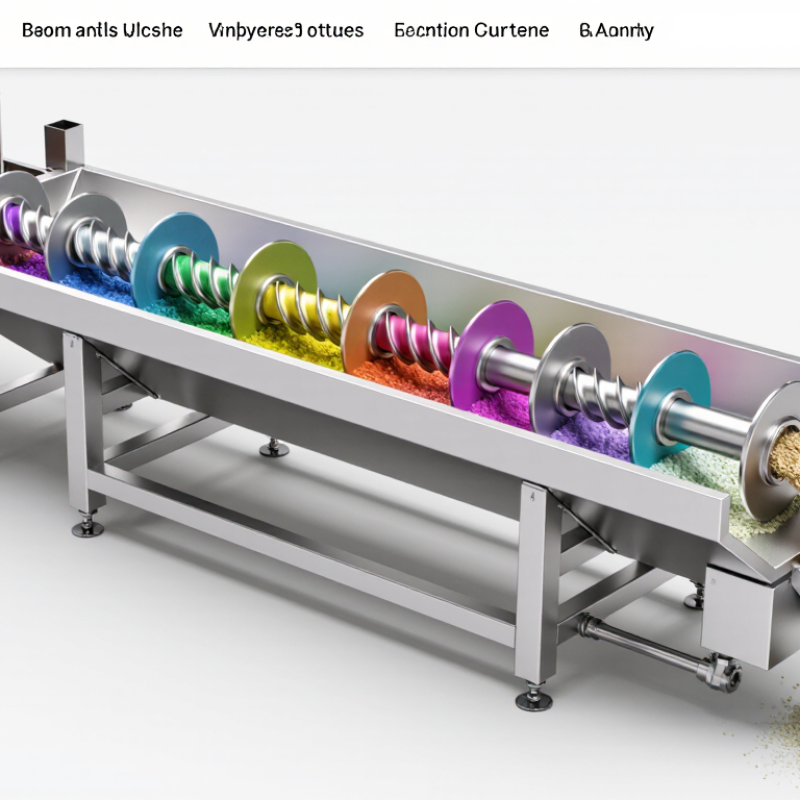
What Is a Horizontal Ribbon Mixer and How Does It Work?

What Defines a Horizontal Ribbon Mixer: A U-Shaped Trough and Central Shaft

A horizontal ribbon mixer is defined by its U-shaped trough and a shaft running through its centre. Inner and outer helical blades sit on that shaft, moving material in opposite directions. One ribbon carries powder toward the discharge end; the other returns it along the trough wall. This creates axial circulation as well as local turnover, so ingredients travel across the batch rather than simply spinning in place.

The trough shape keeps material close to the ribbons, while shaft clearance helps prevent contact with the vessel. Typical design guidance places working volume around 40–60% of gross capacity; Perry’s Chemical Engineers’ Handbook, 9th edition, is a useful reference for evaluating mixing equipment and process design. Actual loading depends on powder flow, bulk density, and ribbon geometry. A small gap matters. Poorly flowing ingredients may leave quiet pockets near the end plates, even when the shaft appears fully loaded. FAO’s 2023 reporting on the Sustainable Development Goal food-loss indicator estimates that 13.2% of food is lost after harvest and before retail; that figure is not mixer-specific, but it underscores why process control deserves attention. Trial batches remain essential, and a clean-looking blend may still hide uneven ingredient distribution.

How Inner and Outer Helical Ribbons Move Material in Opposing Directions

A horizontal ribbon mixer uses a trough-shaped vessel and a central shaft fitted with inner and outer helical ribbons. As the shaft turns, the ribbons move material along the trough in opposing axial directions. Typically, the outer ribbon carries material toward one end, while the inner ribbon returns it toward the other. The exact flow direction depends on ribbon winding and shaft rotation.

This countercurrent movement creates repeated exchange between the mixer’s center and its walls. Particles also tumble and shift across the ribbon edges, helping distribute dry ingredients or small liquid additions. It is a steady process, not instant blending. Powder & Bulk Solids’ equipment-selection guidance places typical ribbon-blender working fill around 30–70% of vessel volume. That range is useful, but not universal: particle size, moisture, and load can change the result. A visibly moving surface does not prove uniformity. Sample several points and test them; that practical check is easy to overlook.

What Is a Horizontal Ribbon Mixer and How Does It Work? - How Inner and Outer Helical Ribbons Move Material in Opposing Directions
Mixer Part or Process How It Works Effect on Material Movement Practical Notes
Horizontal trough A stationary, elongated vessel holds the batch while a horizontal shaft and ribbon assembly rotate inside it. Provides the space in which the ingredients circulate and mix. Troughs are commonly U-shaped or cylindrical, with a cover and an outlet for discharging the batch.
Central shaft A motor and drive turn the shaft along the length of the trough. Transfers rotational motion to the inner and outer helical ribbons. Drive speed and equipment design affect mixing time and the amount of mechanical action.
Outer helical ribbon The outer ribbon follows a helical path near the trough wall. In a common arrangement, it conveys material toward the center of the mixer. Moves material axially along the trough, often from the ends toward the middle. Conveying direction depends on the ribbon helix and shaft rotation; designs may differ.
Inner helical ribbon The inner ribbon is mounted closer to the shaft and has a helix arranged to convey material opposite to the outer ribbon. In a common arrangement, it moves material from the center toward the ends. Together, the opposing axial flows help circulate material through different regions of the batch.
Combined circulation As the ribbons rotate, they create opposing lengthwise movement as well as local lifting, folding, and redistribution. Ingredients repeatedly pass through different parts of the mixer, supporting bulk blending. Mixing performance depends on factors such as batch size, ingredient properties, loading pattern, and operating time.
Typical materials Ribbon mixers are commonly used for dry powders and granules, including blends of ingredients with different particle sizes or bulk densities. Circulation helps distribute ingredients throughout the batch. Material flow, cohesion, abrasiveness, and sensitivity to shear should be considered when selecting equipment.
Liquid addition Some configurations can introduce a liquid through spray nozzles while the solids are being mixed. Spraying can distribute a liquid across the moving solids more evenly than pouring it into one spot. Suitability depends on the liquid quantity, formulation, nozzle arrangement, and mixer design.
Loading and discharge Ingredients are loaded through openings in the cover, and the mixed batch is released through a bottom or end outlet. Discharge openings allow the blended material to leave the trough for the next process step. Correct loading and thorough discharge help reduce unmixed pockets and leftover material.
Operating considerations The mixer is run for a process-appropriate period, then stopped before discharge and cleaning. Operating conditions influence blend uniformity and product handling. Follow the equipment’s operating and safety instructions; avoid entering or reaching into a mixer unless it is safely isolated.

How Batch Mixing Works: Typical Fill Levels of 40–70% of Trough Volume

A horizontal ribbon mixer works by rotating inner and outer helical blades, which move ingredients in opposite directions along the trough. For batch operation, a typical working fill is 40–70% of the trough’s volume. This range leaves room for the bed to circulate rather than simply ride with the blades. Too little material may reduce contact between particles; too much can restrict movement and increase mixing time. The range is a practical guideline, not a guarantee.

Watch the material, not only the gauge. At around 50% fill, dry powder should lift, fold, and travel across the trough, like a slow-moving wave. Sticky or dense ingredients may behave differently at the same volume.

Paul, Atiemo-Obeng, and Kresta’s Handbook of Industrial Mixing (2004) explains how vessel geometry and flow patterns affect mixing performance. ASTM D6128-22 also provides a standardized method for measuring bulk-solid shear properties, useful when powders resist flow.

A small caveat: volume alone can mislead, since bulk density changes the batch’s mass and load. Trial runs help. Record fill, mixing time, and sample variation; then adjust in modest steps. That part takes judgment.

Operating Parameters: Typical Mixing Cycles Last 5–15 Minutes

A horizontal ribbon mixer uses inner and outer helical blades to move powders in opposite directions along a trough. For many free-flowing blends, 5–15 minutes is a practical starting window after charging. It is not a guaranteed endpoint. Particle size, density, moisture, fill level, and blade speed all change how quickly ingredients distribute. A fine salt mixed with coarse granules may need longer than a uniform, dry powder. Watch the material, not just the clock.

Set the cycle with sampling trials. Take samples from several points, including near the ends and center, then compare the target ingredient’s concentration. The FDA’s Process Validation: General Principles and Practices (2011) calls for evidence that a process consistently meets its requirements; it does not prescribe a universal mixing time. ASTM E2500-20 likewise supports science- and risk-based verification. In practice, record batch size, mixer speed, and cycle time together. Stop too early, and pockets of unmixed material may remain. Run too long, and some blends can segregate again. That part deserves attention. A 10-minute cycle may work today, yet behave differently after a change in powder flow or loading.

Performance and Uses: Powder Blends Often Target a Coefficient of Variation Below 5%

A horizontal ribbon mixer blends powders inside a long, trough-shaped vessel. A rotating shaft carries inner and outer ribbons, which move material in opposing directions. This creates circulation across the mixer, rather than simply stirring powder in one place. Operators commonly use these machines for batch blending, but the final result depends on the powder and operating conditions.

For many powder blends, a coefficient of variation (CV) below 5% is a useful performance target. CV expresses sample variation relative to the average measured concentration. A low value can indicate consistent distribution, but it is not a universal guarantee of product quality. Particle size, density, moisture, fill level, and mixing time all matter. A heavy ingredient may settle or separate after mixing, even when samples initially look uniform. Sampling technique matters, too: a few convenient scoops may not represent the entire batch. In practice, the number can look reassuring while hiding uneven spots.

Tips: Take samples from several mixer locations and test them using a consistent method. Record batch size, mixing time, and fill level. Avoid extending mixing automatically; more time does not always improve uniformity. Check the blend after discharge, too.